
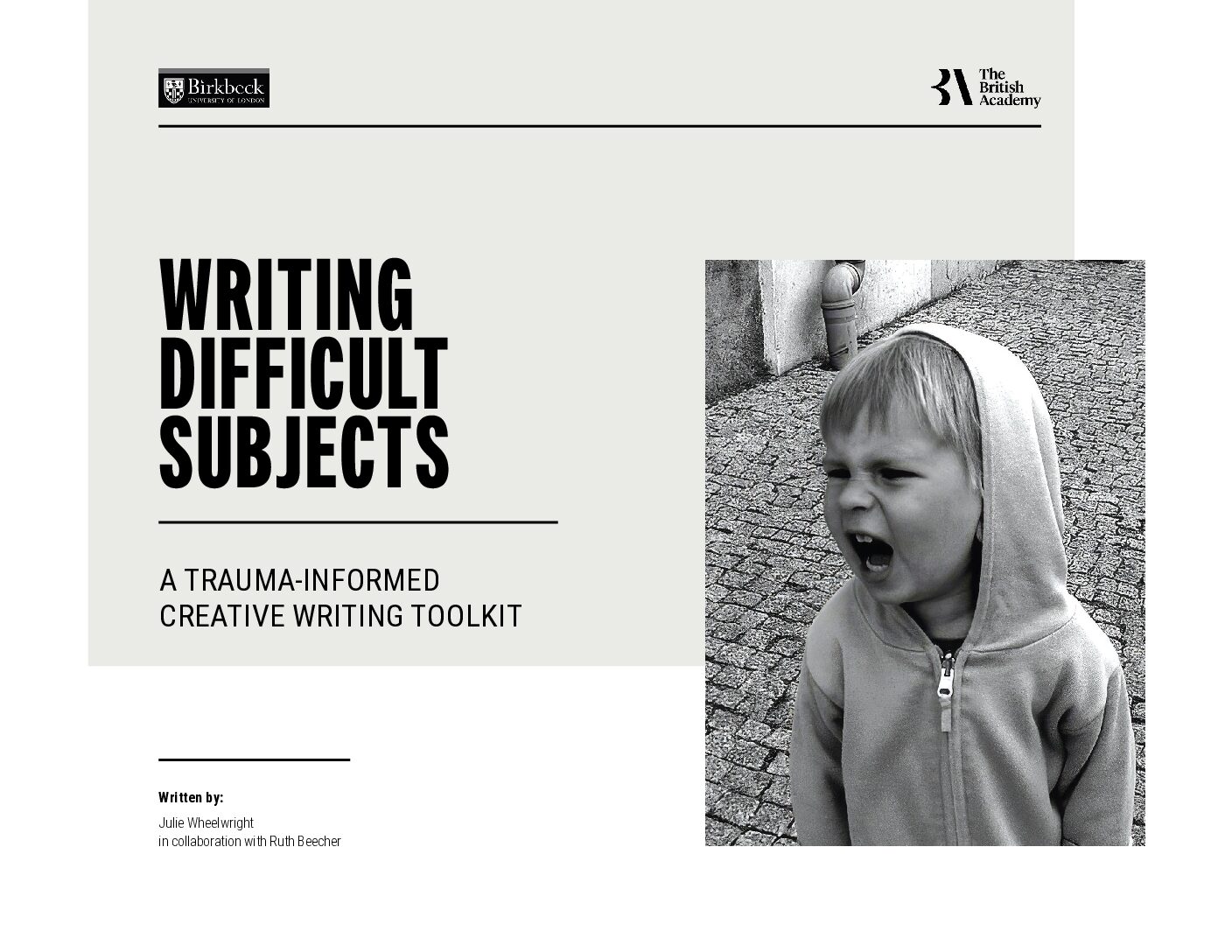
Podcast: Writing Difficult Subjects
In June 2026, historians Ruth Beecher and Julie Wheelwright were guests on the History Workshop podcast to discuss their new trauma-informed creative writing ‘toolkit’ to support those researching complex and sometimes upsetting topics.
Click on History Workshop to listen to the audio of this recent History Workshop podcast hosted by Marybeth Hamilton.
In this blog, we are reproducing the description of the episode by History Workshop (with thanks), followed beneath with the full transcript of the episode.
How can academics write with compassion and ethical clarity about issues of sexual violence? How can they craft works of analysis that are sensitive to the fraught emotions the subject so often calls up? Another way to put this: what does it mean to research and write about trauma with care: care for one’s subjects, care for one’s readers, and, critically, care for oneself?
Those questions provided the spur for an innovative project launched by two historians, Ruth Beecher and Julie Wheelwright. Entitled Writing Difficult Subjects, it explores how academics in the field of sexual violence might process harms associated with their research and develop self-care skills through creative writing techniques. With funds provided by a British Academy/Leverhulme Small Research Grant, they brought academics working on sexual violence together in a series of workshops. From those pilot projects, they developed a digital trauma-informed creative writing ‘toolkit’ that identifies techniques and strategies that those working on sensitive and complex subjects can draw upon as a vital resource. We talk to them about why they launched this project, what they learned in creating it, and why they see it as particularly valuable in the present moment.
You can find links to listen to the podcast on Spotify/ Soundcloud/ Apple Podcasts at History Workshop. A full transcript of the episode is available below.
Transcript of History Workshop Podcast June 2026
Speaker 1 – Titles • 00:01
Come on, let’s go. By shortwave broadcast direct from important overseas capitals, we are about to broadcast
Speaker 2 – Titles • 00:10
this moment in our history.
Marybeth Hamilton • 00:15
Hello and welcome to the History Workshop Podcast. I’m Marybeth Hamilton. How can academics write with compassion and ethical clarity around issues of sexual violence? How can they craft works of analysis that are sensitive to the fraught emotion the subject so often calls up? To put it another way, what does it mean to research and write about trauma with care? Care for one’s subjects, care for one’s readers, and critically care for oneself.
Those questions provided the spur for an innovative project launched by two historians, Ruth Beecher and Julie Wheelwright, entitled Writing Difficult Subjects. It explores how academics working in the field of sexual violence might process the harms associated with their research and develop skills of self-care through creative writing techniques. With funds provided by a British Academy Leverhulme’s Small Research Grant they brought academics working on sexual violence together in a series of exploratory workshops.
From those pilot projects, they developed a digital trauma-informed creative writing toolkit that identifies techniques and strategies that those working on sensitive and complex subjects can draw upon as a vital resource. I sat down with Ruth and Julie to talk about why they launched this project, what makes it critical at this moment, and what they learned in the process of developing it.
And just a heads up, at one point in the conversation, Ruth and Julie read excerpts from work that students produced on the course and generously gave them permission to share in this episode. All of those excerpts discuss traumatic experiences, and one, the first one that Ruth reads, uses particularly graphic language to do so. You’ll hear this moment clearly signalled before Ruth reads the excerpt, so do follow her advice and skip ahead if it’s not right for you to listen to. Right now I wanted to start things off by asking about the title of the toolkit and the course that you devised, which is about difficult subjects. So what do you mean by difficult subjects and why does the process of writing about them deserve attention, consideration, a course to itself? And maybe you could introduce yourself as you give us your thoughts on that
Ruth Beecher • 03:07
Okay, thanks Marybeth and thanks very much for having us here and talking to us today. My name is Ruth Beecher and I’m a Senior Research Fellow at Birkbeck at the University of London. And I guess I’m a historian and an applied researcher, mostly focusing on attitudes and practices about parenting, so the histories of children and families. And although I trained as an American historian, I guess you might say, now I’m focusing mostly on England, Ireland, Scotland and Wales. And my current project is about the ways in which cultural, clinical, institutional ideas about trauma and recovery from child sexual abuse have developed since the 1950s. So really thinking about why a medical model now predominates when we discuss those matters of healing, I guess, after abuse. So that’s who I am.
So you can see why I probably set out on wanting to think more about writing difficult subjects. But I guess we’re talking about any kind of arts and humanities research that is emotionally demanding, often it relates to violence and more often than not to gender-based violence. So harassment, bullying, coercion, physical violence, rape, all of those topics.
But sometimes it’s not to do with that. It’s more to do with politically charged research. Research that is I suppose garnering a lot of interest outside of the university setting, and that becomes very difficult for researchers, especially if they’re PhD students or very early on in their careers And I think what we’re increasingly finding as well is that we’re meeting lots of people who I suppose their interest in the topic has come from their own lived experience. So maybe not from things that have happened to them, but maybe challenges that have been faced by someone close to them, family members, close friends, or something that kind of affects the community that they grew up in. I guess for my own research it’s also a taboo topic, so there’s a lot of denial and silencing around that. There’s a lot of shame around it in everyday settings or in the kind of public discourse. And that can relate to things like disability and mental health as well. That, you know, they are talked about but in very particular ways. And then when you start to do historical research and talk to your friends and your colleagues about it, it brings up all sorts of feelings. and kind of opinions that might be hard to handle or hard to talk about. So I think it’s complicated. It’s lots of different types of topics.
But often what early career researchers in particular talk about is the horror of what we find in the archives. Sometimes it’s really very challenging material that you’re finding, whether it’s in written accounts from a hundred years ago or oral histories that were just recorded last week or ten years ago. Sometimes people are looking at photographs that could contain very graphic imagery. And all of that you feel like all of that is going into your head and that you don’t really have anyone to talk to about it. And then there’s the kind of responsibility at the other end about how do you write about it without drawing in kind of the voyeuristic gaze or causing further harm.
And I guess for me it was very specific to historical research because I think history as a discipline has been the place where there’s just not been that eagerness to address these matters. There’s not been much kind of showing our workings or talking about what’s in our toolkit and there’s a kind of a reticence, which is changing I think now. but still a reticence to acknowledge that there are ethical difficulties, methodological challenges in doing certain types of historical research, and very few resources or space provided for historians who are taking on these kinds of topics.
And it feels like more and more postgraduate students and early career researchers are doing that, you know, taking on this stuff that relates to illness or violence, complexity, things that have a personal resonance. And maybe they’re not always thinking about what impact that might have on themselves or what skills they might need to do that work with people, especially if they’re working with living subjects or you know, people who are in the archives but might have living descendants, that kind of thing.
So they’re spending months and months, you know, getting ready for their PhD, writing and thinking about all of these materials. They’re reading stuff, they’re looking at stuff And really it’s accounts of other people’s pain or other people’s distress. So Julie and I were starting to think about burnout, compassion fatigue, vicarious trauma, all of these phrases that are kind of bandied around. And I guess that’s how we sort of came to this idea of writing about difficult subjects and is there a way to address those difficulties that isn’t sort of just sitting here talking about our secondary trauma? And I think I’ll maybe hand over to Julie because she comes from a bit of a different place from me.
Julie Wheelwright • 08:11
Yeah, my name is Julie Wheelwright, and I’m currently an honorary research fellow at Birkbeck , but I ran a creative writing program in narrative nonfiction for many years. And I also had, a bit like Ruth, I had a previous career as a journalist. And so I think that a lot of my interest in specifically setting up and running a workshop on difficult subjects and trauma writing had come out of my experience of working with students who are encouraged on live writing courses, for example, to think about, you know, sort of events that they could write about for which there might be a readership. And often they’re writing about really traumatic things that have happened to them. And often they come to these projects thinking that, you know, these are sort of issues which are— they’ve thought through, they’re in the past, they’re historical. you know, the emotions connected to them are not still live. But once they start to write, they find that a lot of things are still unresolved. And what I was finding as a supervisor of their projects was that I felt very inadequate to deal with what was coming out, not just for them, but also for me. And it also reminded me of um, you know, the experiences that I had as a journalist where, you know, I was interviewing people who had abused their children, people who had murdered their children, and, you know, people in all sorts of traumatic um situations and again sort of feeling like There were very few guidelines about ethics. There was certainly no support for what I might be going through, and yet I felt that often my work was really important. And I felt, you know, that it was really— almost like it was a sort of privilege to listen to people and that I felt very responsible for my subjects, and yet I also had very little control over how their stories would be received.
So I think all of those things had kind of been in my mind when Ruth and I started talking about, well, what could we do to create a kind of, I mean, I guess I thought of it as a pedagogy or a methodology that would or a way of teaching students or even not necessarily students but early career researchers or any participants who want to write about these difficult subjects. Because it’s not good enough to just say, well don’t write about them because it’s too difficult or, you know stick to a very limited formal form of writing.
And also there’s something so kind of life affirming when people are able to recover language, because after all that is one of the symptoms of trauma that we lose our language or we are kind of disconnected from language. So to be working with people who are able to sort of reconnect with that. So that might be one group of people who are thinking about their own trauma, but also working with early career researchers and academics who are, you know, as Ruth has described, uh, working with this material all the time and there’s no support for what they’re experiencing, what they’re going through. And even though you know, in our workshops who were not asking people to disclose why they had come to their subject. I mean we all know, there’s a sort of shared even if often unspoken understanding that we come to this because of what we have experienced or we come— we come to it because of our politics and wanting to help other people through our work believing that it’s politically important and we want to be engaged in a conversation. So I think that that that was also part of it too, feeling that these conversations, these difficult conversations, if you will, need to be, need to be heard and so you know that I think that that is one part of it.
And the other part of it was you know we can ask why creative writing and creative writing I think enables you to connect with your imagination and I think for a lot of historians are sort of told that imagination is sort of verboten and It’s sort of the antithesis of what you should be doing in academia. So really the workshops were designed to sort of give people permission to start thinking about their writing in in a new way and to sort of acknowledge that imagination is really important in historical writing. I think it’s important any kind of writing and also to think about the aesthetics. So it’s not just, you know, sort of putting words down on a page, but just thinking about all the things that you can do with language. You can be inventive, you can play, you can think of metaphors and symbolism and all these wonderful things that you can do with language, which, you know, if you’re constantly being told that you know that this is nothing to do— this has nothing to do with the experience you’re describing, then it’s terribly limiting. I think it’s terribly frustrating. And I think that that’s also where the sort of repression comes in. So I think those were some of the things that we were thinking about when we when we set up the workshops.
Marybeth Hamilton • 13:14
So when you started having conversations between the two of you about what you wanted to put together, what did you have in mind? What was the aim of the of the overall aim of the project and how did it— how did it take shape?
Julie Wheelwright • 13:29
Well, one of the aims of the project we felt was to create some kind of document or, you know, we’ve called it a toolkit that would be available to people who are thinking about writing difficult subjects in the way that we’ve just described it. And like where would you start? What could you do? How could you go about building a community of people who are not just working in this area or working in this field but also build a community with other writers.
Because I think that one of our aims was to think about reaching people across disciplines and giving them some really practical tools on how you could do this yourself. So we’d actually run two, over two years and run two separate workshops. And that had actually been preceded by another workshop that I had done with Joanna Burke, where we were working with a group of women veterans who had experienced military sexual trauma So, you know, a different form of difficult subjects. And sort of putting this knowledge together in a way that would be accessible not just to people who are writing about sort of sexual violence, but really to anyone who was writing about trauma and was thinking about setting up their own workshop or even working through some of these things themselves and wanting the skills and tools of creative writing.
Marybeth Hamilton • 14:52
Ruth, did you want to add to that?
Ruth Beecher • 14:54
Yeah, I guess I guess to talk about my own experience, like my historical research is focused on child sexual abuse since 2018. And I mean, yeah, it’s about child sexual abuse, but also all the other forms of abuse that come with that. Emotional, physical, you know, it never comes by itself. So whatever you think about why child sexual abuse happens, it’s like horribly exploitative of children, by adults who kind of put their own wants and needs before those of a child. And so, it’s— I knew it was going to be unpleasant material and hard to think about full time. But I was a parent of four children, two homegrown, two adopted. I had worked in children’s services for decades. So I felt like, oh, I’m pretty resilient. I’m not gonna be sort of worrying about vicarious trauma or— and also I felt like I had a pretty strong ethical framework in terms of thinking about the child, thinking about the adult survivors.
But like when you actually start to do the research, and this is like whether you’re an anthropologist, I think, or a historian or sociologist, the first thing that happens is that nobody just nobody wants to talk to you about it. Not in any detail at all if it’s a subject like child abuse. So even other people I found, most people who study child abuse are in like sociology or medicine. So they’re like does this CBT intervention work with this group of children? Or, you know, what are the statistics on prevalence in the Global South? Or, you know, they’re very far removed from um the kinds of research I’m doing, which is like about the ways children are silenced or thinking historically about like the different ways that people have tried to change understandings of child sexual abuse.
And also like there’s terrible feelings involved in this, right? Because children are living with people who love them and they love, who are also raping them. It’s the most complicated, awful situation. And so you’re— you’re in that in that by yourself because nobody really wants to talk to you and they say to you, but you know, it’s all out in the public now, you know, because look, we had Jimmy Savile and now we’ve got Jeffrey Epstein and you’re like— But they’re that you’re just talking about powerful men and you’re not talking at all about child abuse or victims. So it’s a very frustrating feeling and you can get quite sort of distressed by that. And then secondly, the impact.
So even if you are used to information about child abuse, you’re used to working alongside social workers or nurses, doctors, the stories that you read, the images that you see in the archives, they begin to accumulate and the more— the more you see it, it’s sort of it builds up, it gains more power in your mind, you know, and then suddenly you’re like trying to make the dinner and you’re finding it quite difficult to pay attention to what your partner is telling you about something to do with your domestic life. You know, you’re like, how is that important? I really don’t care if the dog needs to go to the vet, you know.
Um, so we had one of our participants as well and I’ve got a little quote from them because I think it sort of really says it as well. And they said:
While I was doing the research, although I was working with fictional texts I did read testimonies as well and I read the scholarship and I felt kind of really I was in constant rage and tension. I expected it wouldn’t be as hard because I wasn’t dealing with people. I wasn’t actually talking to actual people. But it still had such a huge impact on me. And I mean this affected my relationship that I had with my romantic partner and I took many things out on him. It wasn’t him. But like your feelings have to go somewhere almost and I didn’t have an output. and the very academic writing wasn’t an output.
So I think that sort of really feeds into this— the rationale for having something that was creative and freeing rather than constraining. And I did notice that there were lots of early career people. They were going to meetings and they were just saying the same thing over and over, like about secondary trauma and worrying about it. And I was starting to find it frustrating because it was almost like they could only talk about themselves. They’d forgotten about the people they were researching.
So I think that we were really thinking of a way to free people up from that and for them to get some release without sort of having to— it— because I think they were revisiting it without actually finding a way to mitigate it. So I think for me that was really, well, would this thing this set of workshops, this set of six workshops, and going away and doing your own writing, is that a way to address it without confronting it head on and, you know, having therapy for it? Or, you know, was this a way to make space and to let our imaginations kind of be looser, you know, without those constraints of having to write a journal article or a chapter of a book or anything like that. Just kind of open up to that and I think that was why we did it and I think it was really, really a great sort of space for that.
Marybeth Hamilton • 19:51
So maybe this is the point where you could talk us through the content of the course. You know, talk us through why you designed it the way you did, given what you’ve told us about the aims of the course.
Julie Wheelwright • 20:04
Yeah, well it was really taking, I think, sort of six elements of creative writing and dividing them up into looking at skills. So, for example, we looked at things like plotting, character development, descriptive language, and then also looking at how language is structured and how stories are structured in terms of how do you develop a plot? How do you begin a story? How do you end a story? How do you decide when something is finished?
So all of those basic techniques and it was it was really designed as in in some ways a kind of pretty standard creative writing workshop so I gave the participants prompts every week, encouraged them to write. And one of the things that we implemented this time round was we gave everybody a journal. So everybody had a sort of physical journal and came with a pencil or a pen and we had a free writing exercise at the very beginning. So that prompt and then would suggest that people went away and thought about developing that as a piece of writing. And it was really gratifying to see that some of the participants actually did develop those pieces and they’ve even used them in their academic work. So that was a wonderful outcome.
So six workshops where every week there’s writing prompts. Every week we had students doing a bit of free writing. So that they could kind of get over that idea that this is something difficult or complicated or hard to do. My approach is that writing is— it needs to be demystified. I think there’s an awful lot of stuff that’s built up around writing and who are writers and I think, you know, all of us have that capacity to express ourselves, but you know, not all of us have had the, you know, the time or the space or the freedom to sit and write about things that we find interesting and important and exciting. And so that was one of the opportunities.
One of the other elements that we looked at was we had extracts from great writers, but also writers who have thought a lot about the process of writing narrative nonfiction, but also fiction and also writers who have thought about writing difficult subjects. So we had extracts from a few memoir writers and, you know, really looking at— really sort of thinking about writing difficult subjects as a kind of complicated problem. and who’s come up with solutions and do those, you know, and then debate and discussion about whether those particular solutions work. And students also did kind of feedback, critical feedback of each other. I think they found that really useful. And it, you know, I thought that that also stimulated a role a lot of really interesting conversations around things like ethics and how we treat our subjects and what kind of insights and reflections we bring to our work. And at the end, you know, we— the first, the first set of workshops that we did we actually got students to write a kind of final piece. We didn’t, we didn’t do that with the last with the last group, but I think a lot of people came away feeling that they had produce something that they were really pleased with. I mean they weren’t necessarily long pieces, but I think that, you know, they’d sort of conquered something or felt like they’d mastered a bit of technique and that a lot of them said that it had inspired them to keep writing on their own or to find, you know, develop a community of writers so that they could encourage one another to keep writing.
Ruth Beecher • 23:47
I mean, I think one of the things we were thinking was, I mean, universities do have a responsibility to look after people, right, who are doing postgraduate study with them, who are being engaged on short-term research fellowships on grants and things like that. But given the sort of climate at the moment and the state of the humanities, we did want to produce something that could be run by an institution or by a group of interested researchers within or across institutions.
So, you know, it needs Ideally, we think it needs a room and a space to come together, but it can be a virtual room as well, depending on what’s available to you. But we thought that was really important. And I think we were also very conscious that like there’s some really good guidelines been produced now by Manchester, I think Bristol, Westminster, Portsmouth, lots of different universities, some of them working together, like the Reswell is a cross-university guide and they’re about like researcher well being. But there was— we couldn’t find anything really could we Julie that was like practical, that were techniques to support people with their self-care and with creative writing.
And one person on the group said in the evaluation that this series of workshops was the first time like they’d had any opportunity to attend anything like this, any sort of supportive space to consider the impact of their research. And this was someone who’s like on their second postdoc. So they’ve done their PhD and their first postdoc looking at violence and trauma amongst young people and young men and young women, but they’ve had nothing like this. No, so we wanted really to produce something that would be could be replicated and picked up even if there was not that sort of resource set aside for the— for the care of postgraduates.
And I think also on the second group we tried really hard to reach a more diverse group of participants. So I think we had a mostly white group on the first time we ran the the course and then the second group we put a lot of thought into the materials and into targeting particular places so that we could get a more diverse group and I think again that is needed. One of the Black researchers on the project said that they’re looking at archival materials and oral histories as part of their PhD and that they find it especially difficult managing the emotional toll as a Black woman researching Black women in a predominantly white institution. So that person specifically wanted a space to talk about those issues knowing that there would be other people of colour in the group and so that I think is something to really think about as well. Like It’s not just enough to open up the group. We did put some funding in as well so that people who perhaps didn’t have funding for travel could travel to us and I think those things do help to widen the participation, so they’re quite important as well.
Marybeth Hamilton • 26:55
I think you’ve brought with you some extracts of work that the students produced because I wanted to get a feel for both what the course elicited from participants and your own responses to it and maybe using it as a kind of illustration of the way that the course was trying to address certain needs. So did you want to sort of take it up from there?
Ruth Beecher • 27:25
So I’m going to start and the piece that I’m going to read contains very graphic descriptions of sexual violence. So I guess for any of our listeners I think it’s going to last for about two minutes, so feel free to mute us for about two minutes. And it’s by Adeline Moussion Esteve, who’s a postdoctoral researcher at Birkbeck and it’s called the Dynamics of Difficulty.
Sarah’s Flat. A wooden desk displays a computer, some notebooks, a flask of water, a coffee mug, an agenda. The room is filled with books. The whole room is in semi-obscurity. The light is focused on the book that she is reading. Some pens and highlighters are dispatched here and there. The room is silent. She sits at her desk and is reading a book. She begins an inner polyvocal monologue.
Anxiety speaks. I know I postponed the moment to open the book, right after having flickered through the first chapter, I knew it would be a rather different way of describing violence than I was used to in the literature, and then what I would have wanted.
PhD student speaks. Still, this is an obligatory read. I cannot write about her objectively without discussing it.
Now the book, and this is a quote. At the onset, he wrenched my wrist and forced my body over his by grabbing the back of my head and inserting his penis into my mouth. His control of my body varied from pushing his penis into my vagina to his forcing me to lick his penis and anus with continual variations of these as pleased him over a three and a half hour period. End of quote.
Disgust speaks. Penis in her mouth, penis in her mouth, pushing his penis, pushing his penis, licking a penis, licking a penis. She sighs.
Anxiety speaks. Calm down, heart. Tachycardia, go away. Breathe. Calm down. Feel your breath and body.
So we did think a lot and talk a lot, Julie and I, about whether to read all of this piece. We felt that it’s a superb kind of description of the different parts of your mind that are wrestling with reading this really graphic text. And we felt that if we cut anything out or sort of bleeped anything, it would lose its power or it would, it would no longer convey the same meaning. But this is something that we talk about a lot, which is that sort of transmission of violence, whether it’s doing further harm to describe things graphically, what to, what to include and what to leave out.
Julie Wheelwright • 30:29
Yeah, I mean we talked a lot in the group as well about what one writer has described as the pornography problem and the whole problem of language and eroticization and not wanting to replicate that, but at the same time acknowledging that we don’t have any control over how our work is going to be read. I mean we can give our reader direction and we can think as carefully as we as we can about the language that we use, but ultimately it’s up to the reader to decide how they’re going to respond. And we won’t necessarily know how they’re responding anyway. And these are really complicated problems because if you don’t use description, then your reader may not know what has actually happened and you’re depriving your subject of something. You’re depriving your subject of their voice.
I had read Manon Garcia’s book about covering the Pelicót trial. And one of the things that’s really brilliant about that book of essays is her description of sitting in that courtroom and having to watch these videos of men raping this woman and how does she describe that. And she talks again about this problem of eroticization. And one of the things that she notices after a while, at first she feels kind of sick and you know, she has this very strong reaction to seeing these images and sort of wants to do anything other than look at the screen. But then she says after a while she notices that her reaction changes and it becomes very boring. And she realizes that these men are very infantile and their language is very limited and it’s very poor. And I thought that that was such an interesting insight because, you know, you can sort of contrast with the richness of language and the richness of description and human ideas and interaction and everything else and set that against the sort of, well, I guess it’s kind of the banality of— the banality of evil. And I thought that was a really interesting approach. And the and this is sort of, I think, a really good illustration and this piece that Adeline wrote about how we need to explore, you know, different ways of describing these things but we need the time and space to do that. And I think that we also need the community that’s going to help us decide you know whether these approaches are worth further exploration and whether they’re sort of conveying and communicating what we need them to communicate. Because it does feel in a way that if we think about it in terms of sort of second-wave feminism and me too and everything else that we are just at the very beginning of something. We are at the very beginning perhaps of new ways of thinking about talking about these experiences because they have been so shrouded in shame and secrecy and silence.
Ruth Beecher • 33:26
I mean, I think also, I mean Adeline has very generously allowed us to read this piece, but I guess what it points to is like the safety of the group as well, because as Julie says, you’re testing out how something lands. You know, you don’t quite know, like you don’t quite know I think especially if you’ve been enmeshed in the subject for a long time, you start to lose your perspective actually on what like our broader reactions and responses and everything else. And I think that was one of the things that people found extremely useful about the group was just to let go, write what you will, get the responses of the group if you want them. And people were so generous, weren’t they? And so kind in how they fed back to each other and kind of nurtured each other without sort of they weren’t all best buddies or anything like that, but the space in the room was very, a very, very safe space. And I think to be able to write just to get it out and to experiment with it, not for any wider audience, is very powerful as well.
Marybeth Hamilton • 34:33
So Julie, I think you were going to introduce the second extract.
Julie Wheelwright • 34:37
The second extract is by Katie Elliott. So I think this was in response to we were thinking about narrative perspective. So trying to tell a story from different points of view. So this is called From Pillar to Post.
The words jumped off the page, streetwise, addict, promiscuous, prostitute. Kay had heard these words said about her before. Over years she had got used to feeling less than human. Seeing them in black and white about her sixteen-year-old self felt doubly cruel. I was barely sixteen, Kay said to herself.
Kayleigh has been seen getting into men’s cars. Kayleigh is chaotic. Kayleigh will not engage. Kayleigh was arrested for soliciting. Kayleigh is prostituting herself.
Plain as day, Kay knew for certain that she had been written off from the start. How could they not see the signs? My life was out of control and they thought I wanted it?
With tears in the corners of her eyes, Hannah looked at Kay and said, I’m sorry for what happened to you. I’m sorry you didn’t get the help you needed and deserved.
Kay could read people, and she knew Hannah was sincere Hannah went on, things are different now. Kay wished she hadn’t said that. She looked Hannah in the eyes and asked, in what way are things different now?
I think that that piece really says a lot about, you know, again, we’ve been talking about imagination and having to sort of engage with scenario and I think that here Katie ‘s done a really wonderful job of sort of imagining these two perspectives. It’s almost as if there’s three perspectives in this reading because there’s, you know, the words on the page, sort of just these very, very brief one sentence descriptions of Kay or Kayleigh who has been condemned by all these various people in positions of authority when she was a teenager. So that almost, it’s almost like they form a separate perspective themselves. And then there’s Hannah the social worker and then there’s Kay/Kayleigh who is maybe the predominant voice, but you can see all of these three different perspectives in tension. And I think that, you know, one of the things that was really great about the pieces that people produced was that even though these are very short pieces, I think there’s so much going on in them. There’s so much that is being said and so much that we can think about in terms of, you know, all the things that maybe still continue not to be spoken about, and whose voices are not being heard, and whose voices predominate when they perhaps shouldn’t.
Ruth Beecher • 37:35
Yeah, I mean I think for the person who wrote that, Katie , who’d come from like a sociology PhD as well, I think it was very freeing for her, maybe a bit daunting, but also very freeing for her to try and put herself, you know, to produce something that was very different. And she’s done it really well in such a short, small number of words, you know, it’s like, it really conveys those different perspectives and the kind of labelling of young women and the fact that perhaps professionals all always look to that golden future and think that things are getting better all the time and perhaps what historians have in common with survivors is that we’re not so sure that we’re on like a glorious road to progress. So, I think she’s made a really good job of that.
Marybeth Hamilton • 38:24
So the third extract, I think, is a bit of a change of pace. It’s not directly related to sexual violence and in this case, the author’s male. Julie, do you want to talk about that?
Julie Wheelwright • 38:42
Yeah, well the piece that I’m going to read is by Rémy-Paulin Twahirwa and it’s called Chips Out. And the reason why I wanted to include it, aside from it being just a fabulous piece, was that when we when we were doing the workshops, people weren’t necessarily always writing about sexual violence. Their background wasn’t necessarily, as early career researchers or academics, wasn’t necessarily in sexual violence. But often they were dealing with difficult, complicated subjects.
And I think that Remy in this piece really sort of pierces through a lot of layers of emotional and political complexity to give you these two characters and the relationship between these two men, which completely humanizes them. And I think that in order to get to that point of writing a piece like this, there’s a there’s a lot of a lot of skill that’s involved, but there’s also a lot of, I think, deep and reflective thinking. And so I think that his piece, Chips Out, really accomplishes that.
The wrinkles on Hassan’s forehead faded. He slipped his last domino into the deck, then stood up with a loud, jerky gesture. He was the first to empty his hand.
Boom! You owe me five pounds each, he said to the other players.
Hassan, you’re cheating, that’s impossible, shouted Yusuf gesticulating on his chair.
Another player protested, calling for another game. Maurice the Ivorian insisted that they should exclude Hassan from the other games The group laughed at other remarks made more to boost Hassan’s ego than to rob him of a well- deserved victory. Hassan defended his honour, then apologized. He wanted to smoke. Yusuf followed him.
So he said it’s decided.
Hassan shrugged. And you?
Yes, I’m telling you, they’ve withdrawn my visa. Two months, two months now.
Hassan took out a cigarette from a blue packet in PalL Mall. He lit it and took his first drag. He felt a warm caress around the back of his neck. Yusuf reminded him of his little brother Ali. Like Yusuf, Ali had travelled to Libya. He had used money lent by the rest of the family to pay for the journey from Janet to Tripoli. But unlike Yusuf, Ali had taken the wrong boat. Too small, some experts said in the press a few weeks after the shipwreck, two hundred souls fleeing the misery and suffering that the World Bank and IMF, militias and corrupt governments had to offer to Africa’s youth. Two hundred souls in the belly of the Mediterranean.
If you fill in this form, you won’t be able to come back, Hassan advised Yusuf.
Yeah, but what if they arrive today and say to me, you’ve got your flight? There’s nothing I can do about that either.
Nothing, replied Yusuf, doing push-ups against the wall.
Hassan remained silent. He threw the cigarette butt into the ashtray by the door. Yusuf was right, it was a possibility. Two days earlier, men dressed all in black had run through the common room. A few minutes later they had returned with a half-naked man on a stretcher, his hands and legs tied, his guttural yells were like those of a trapped animal calling for help. Hassan knew these cries well. They were the screams emanating from the corridor leading to the room where opponents of the regime were dealt with. The cries of men who had to be forgotten or broken, men like Hassan.
And I think, you know, again, we’ve got something which is actually a really accomplished piece. So not only does Rémy give us character, but he’s also using dialogue. He’s done great scene setting. He’s also done a great job of building up this sense of tension, get a sense of the relationship between these two men. And you also get a sense that that y uh of the political context and background here of what’s at stake for them. And I think it’s just you know, again sort of a very short piece, an extract of a short piece and so much is going on and we can learn so much from that. And I’m sure for the lot of the participants who were doing writing these short pieces, it was, I think for them it felt like a kind of release in a way to be able to think about their subjects in a different way and to connect with them emotionally on this kind of more human level than the sort of objectified, distanced writing that the academic writing requires.
Ruth Beecher • 43:33
He just did a beautiful job of sort of drawing us into this game, didn’t he, at the at the outset. So yeah you really get to know the characters and you take to them, don’t you? You feel that connection with them before he tells you about this terrible tragedy that’s happened and then he’s just got one or two sentences that give you that broader context kind of tucked away in the middle of the piece. I think it works really beautifully. And I also think that a lot of people on the group did talk about how they might be a little bit braver in their academic writing about using some of those techniques from the workshops, you know, because, you know, I don’t think we think overtly about plot and character and dialogue when we’re doing writing like a chapter for a book or trying to write a monograph or our PhD thesis. But it that’s what we’re doing all the time, you know, in different ways, even if we’re doing lots of mini sort of mini structures or one uber structure, you know. I suppose the most confident of intellectuals uses these techniques all the time to engage their readers and to, you know, to write trade books and make the kind of money they can’t make in a job in a university or so. I think, yeah, lots of people on the course did start to think about not only using this for self-care, but also, oh, are there bits of this that I could actually use to make my historical or my anthropological writing more engaging and kind of inform that structure and narrative and engage people with characters, especially if the sources are quite limited and you’re trying to be creative with a small amount of material.
Julie Wheelwright • 45:26
Yeah. And I think one of the other things I think we did that was really useful for people was to think about editing. Um because there’s a lot of things that we can do with writing that can improve its flow quite dramatically and they’re often, they’re quite small things, but you just have to know what they are and to watch out for them and to be prepared to be edited. So, you know, as we were discussing earlier, and to think about aesthetics. So how does it sound? You know, we’ve been reading these pieces out, which is actually one of the techniques. that I would advise people to use, like take a piece of writing and read it out and how does it sound? Because often you can hear things when a piece is read out loud that you wouldn’t necessarily get from just reading it as a piece of text
Marybeth Hamilton • 46:20
So I have a kind of vague question, which is just about how the exploration that your students are able to do on this course was part of your intention to kind of open up people’s awareness of what— I’m not quite sure I can articulate this right— but what position, formal, conventional, academic third-person writing places them in in relation to their subject and that they can then, you know, explore alternatives to that and see whether that creates a kind of more, what would the word be? Ethical, ethically upfront stance from which they can write and what the different possibilities are. Because we certainly don’t learn that as part of a PhD program. And I just wondered if that was one of the kind of aims of the course was to create that openness and experimental capacity in students who took the course?
Ruth Beecher • 47:28
I think a lot of them came with that openness and they were already thinking. They sort of had perhaps started researching their particular topic because they wanted to have impact, not just because they wanted to have a PhD or—. So I know that when we did the evaluation, a lot of the feedback was I was already thinking about creative ways to explore my topic. I was already feeling like we have to embrace multiple ways of disseminating research. So I think definitely the participants, many of them brought that to the room.
I don’t think they necessarily had the confidence to, you know, I think often they’re thinking about those things as very separate, like If we think about Rémy and the zine, you know, Remy ‘s put a lovely piece of writing in this amazing zine, which is all about social issues and is fantastic. And then there’s you know the sort of academic work over here, so there’s that mixing it up as well but I I feel like there’s more and more interest in in doing that in, across the professions as well.
But then we maybe sometimes are a little bit swayed in the humanities, because I think when I go to a conference then and it’s a multidisciplinary conference, I realise that is not the sort of vibe at all in some of the other disciplines. It’s still extremely rigid. And I guess also, you know, I’m very lucky to work at Birkbeck. We have a very creative and radical group of colleagues there, whereas certain universities, I’m sure, are much more sort of traditional in their approaches to both doing the archival research and writing about it and publishing and I feel that from some of my colleagues. You know, it’s like which journal have you tried to get this into? You must write like this for this journal and only that journal counts, you know, because that’s going to give us better, I suppose, better reputational rewards, you know. So perhaps it’s the people I’m mixing with. If you’re mix, if you’re doing this sorts of research, maybe you meet with people who are slightly on the edge of disciplines anyway and crossing over the disciplines. But definitely I think they came with that, didn’t they, Julie?
Julie Wheelwright • 49:44
Yeah, and I think that, well I don’t know, I mean I’m just such a great believer in thinking about just writing better and that being a goal in and of itself and everything else stems from that so you can be more effective in terms of conveying your research but also I think that you’re more deeply engaged with your subject because I think that one of the things about thinking more creatively about writing is that you have to look at things from different perspectives and different angles. So if we if we think about the piece that Rémy has just written, all the things that he has noticed in terms of what you know the card games or their smoking or even the body language between the men. All of those are observations which he’s brought to his writing, which wouldn’t necess— wouldn’t necessarily fit into again into an academic piece. And yet they tell us so much about what’s actually going on and they humanise these people. And I think that maybe that’s where the ethics comes in as well. You know, and we want to be accurate in our observations. We want to talk about real people, places and events, things that have actually happened. And I think sort of making a commitment to that is a sort of an ethical stance in and of itself.
But also beyond that, that this is a sort of a more effective way of communicating our research and you know at the end of the day engaging with people because these are dark and difficult times. Absolutely. And one of the difficulties we’re all facing is getting people’s attention because, you know, we live in an environment where all these different things are competing for our attention all the time. And now we’re also having to grapple with artificial intelligence and being told— I mean I was thinking about that, you know, the ways in which we’re constantly prompted to um to change our grammar, spelling, punctuation, but also to change our sentence structure, or we’re being offered words through AI assistance and we don’t want that do we always? You know, where is human originality and engagement and thinking through what is the best way of expressing this human emotion. So I think that those are also things and questions and conversations that we brought to this workshop and I hope we will bring to other workshops as well in the future. And I’m just really so eager to know how people are going to receive this. And I hope we’ll get lots of feedback, don’t you, Ruth? In terms of the handbook and how people are experiencing it.
Ruth Beecher • 52:28
Yeah, absolutely. It would be great to for it to be used quite widely and to get lots of feedback about it. And I think what you’re talking about is really like creating that space to be ethical on an ongoing basis because I think especially if you’re like a junior researcher, which I, you know, I would call myself because I transferred like, you know, I’m on my second career. So I haven’t been doing historical research since I was eighteen. I started when I was, you know, in my forties and there’s a temptation if you want to do research that matters to sort of oversimplify for your ethics committee, you know, because you want them to think yes I’m a very responsible person and I’ll do it like this and it’s all very straightforward. But it is not straightforward and people need the spaces, I think, to keep open to admitting that it’s not straightforward and that it’s not like a criticism of them. It’s not a sign of their weakness to talk about the complexities of this and to think about their own well-being, the well-being of the people that they’re researching, and kind of to build a community of people that they care about as well. So I thought that this workshop worked really well theoretically at least, as a kind of a triangle of care, you know, for self, for other researchers, and for the research participants.
And also I think that even beyond ethics committees, you know, when you’re putting in grant applications, now the latest thing is to say everything’s trauma-informed and then put some money in your grant application so that people can have counselling or therapy and I just think that’s, doesn’t make sense to me, you know. People should not only take on difficult subjects if they have hundreds of pounds to pay for personal therapy. There’s not even any research to say that A, they need it and B, that it works for what they’re doing.
But I think we do know that we need to make a space for reflection. We need to make a space to think about difficult things, but also like to let our minds wander. You know, you know, not to always have a structured conversation, but to let some of those dark thoughts come in and then see where they take us and have people around us to kind of help us to navigate. So I’m not saying we ran some brilliant workshops. I think Julie did run some brilliant workshops, but I do think it’s got potential to create community and to be a kind of a tool for people at a place where they can say upsetting things and not be really judged for like being, you know, saying something outrageous or offensive that— You’re making a space of safety, I guess. And a space for people to think through these dilemmas and to talk about their anxieties without being kind of shame shamed really for it. So I think that’s the potential of it and that’s why we hope that a lot of people will make use of it in whatever different ways and then will come back and tell us about it and it’s going to be on our website. We’ve got a website called Sexual Harms Research Alliance and within that we’ve got a project page for Writing Difficult Subjects. So we’ll have it there and hopefully we’ll be able to create some kind of feedback loop for people as well. [https://shra.bbk.ac.uk/writing-difficult-subjects-a-trauma-informed-creative-writing-toolkit/]
Julie Wheelwright • 55:45
Yeah. I just wanted to add to that that I remember someone in the workshop saying one of the things that they appreciated about it was they didn’t feel like they were in competition with other people, that there was this sort of sense they were just doing it all because they wanted to be there. And there was a kind of shared communal sense of, I don’t know, endeavour or exploration. And, but it wasn’t about getting brownie points or you know, showing off or anything like that. So yeah, I think that, I think, you know, these conversations will go on because they’re necessary and people are up for the fight.
Ruth Beecher • 56:24
I think it’s good to have a framework for them though, and try and help people to have them and also just to show people that it’s okay to have them. This is part of being a researcher is to make space for things like this. And I do think that’s really important because I think otherwise people start to just like just feel that like they just start to become very inward looking and it just begins to feel like an unclimbable mountain, doesn’t it? Like that sort of, there’s no point, you know, because this research has had their funding cut and my university won’t even provide me with regular supervision or whatever it is, all of these barriers. So the nice thing about creativity is people do feel that sense of optimism, don’t they? You have to have permission to do something. You need a way to do it, a sort of a language for it.
Marybeth Hamilton • 57:15
Many thanks to Ruth Beecher and Julie Wheelwright for taking part in this conversation. You can learn more about them and their work on the episode page for this podcast. Please visit our website, historyworkshop.org.uk. You can find us on BlueSky at HistoryWO and on Facebook and Instagram as History Workshop. This is the History Workshop Podcast. I’m Marybeth Hamilton. Thanks for listening.
MORE INFO ABOUT THE PROJECT
www.shra.bbk.ac.uk/projects/writing-difficult-subjects
CONTACT US
Telephone: 020 3926 3679/ 020 3926 2813
E-mail: r.beeecher@bbk.ac.uk or j.wheelwright@bbk.ac.uk
