
Reaching Black Survivors of CSA to record their oral histories
We are gathering survivors’ testimonies about living with the impact of child sexual abuse, as well as those of practitioners. Where we want and need to do better, is to ensure our oral histories project is accessible, welcoming and safe for Black participants.
Our message to Black survivors and practitioners is:
We want to include your testimonies in what will be an important (and the first) archived collection of oral histories about experiences of recovery/ living with the impact of child sexual abuse in Ireland, England, Scotland and Wales.
Below we set out some background on what we are aiming to do, the context for why we are reaching out and the steps we are taking.
The Recovery Histories project aims to produce the first social and cultural history of recovery after child sexual abuse in England, Ireland, Scotland and Wales covering the last 70 or so years. We want a broad range of survivors and practitioners to have the opportunity to record their oral history. We are really fortunate that so far, we have been contacted by a diverse bunch! People from all over have been in touch and they come from a different cultures and genders. We are in the process of gathering the testimonies of people from White Irish, South Asian and White British backgrounds. People who self-identify as neurodivergent are also participating. In terms of geography, we will be focusing more on fieldwork in Ireland, Wales and Scotland over the coming months so if you are from those areas, please get in touch. As noted above, where we want and need to do better, is to ensure our oral histories project is accessible, welcoming and safe for Black survivors.
University-based research is a space dominated by white privilege. In research, funding is often inaccessible to people of colour. As our funder Wellcome points out, this is particularly true for Black researchers in the UK who are less likely to be awarded research grants than white researchers. Only 3.6% of all academics in England and Wales are Black. This is despite Black people making up 4.4% of the working age population.
From our perspective as feminist historians who strive for anti-racist practice, historical and ethnographic research that does not include the voices of Black survivors and practitioners is of limited value.
As Imkaan’s 2024 report ‘Why Should Our Rage be Tidy?’ demonstrates, the context of minoritised women’s lives and the compounding effects of historical and contemporary processes of discrimination and racialisation add to the trauma of interpersonal violence-abuse. Researching a sensitive and taboo topic like child sexual abuse brings further challenges.
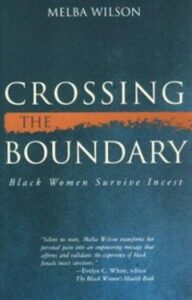
In the early 1990s, Melba Wilson pointed out that fear within Black communities about fuelling racist stereotypes relating to Black people’s sexuality led to increased stigma and greater secrecy surrounding the abuse in those communities. Wilson was a Black activist, journalist, health campaigner and survivor and a true trailblazer. Prior to her ground-breaking book, Crossing the Boundary: Black Women Survive Incest, there had been almost no research on the interface between race and child sexual abuse and what little had been published originated in the US. Understandably, Wilson felt nervous about ‘exposing the dirty linen’ of Black communities where, she wrote, ‘tacit approval is given to keeping incest … under wraps.’ Crossing the Boundary did a lot to challenge stereotypes but 30+ years later we know that there continue to be many specific barriers to recording testimonies.
We are:
- working with our Lived Experience Advisory Group on how we reach potential oral history participants.
- researching and training in the best ways of approaching cross-cultural oral histories in terms of methods and the ethics.
- a small diverse team (South Asian, white Irish, Black British, white French and white English) but our oral historians (Katie & Ruth) are white. We understand that some Black survivors or practitioners may prefer to be interviewed by a Black oral historian. We are seeking to collaborate with Black oral historians so that we can offer this choice.
- reaching out to ‘By and For’ organisations to ask for their support and advice.
- happy to visit any Black-led organisations to answer questions about the project and to discuss the oral histories or other ways that people may feel comfortable to get involved.
- keen to have constructive conversations with individuals or organisations about any aspect of the research and how we can do better.
CONTACT US
Telephone: 020 3926 3679/ 020 3926 2813
E-mail: recovery-histories@bbk.ac.uk
Acknowledgements
Faith Uwadiae, ‘Work in progress. From learning to action: how we’re strengthening Black-led research initiatives,’ 28 Jan 2026. https://wellcome.org/insights/articles/learning-from-organisations-support-black-researchers
Ravi K. Thiara, Sumanta Roy and Akima Thomas, ‘“Why Should Our Rage be Tidy?” Minoritized survivors’ experiences of mental health in the context of violence-abuse’ (Nov, 2024). https://www.imkaan.org.uk/why-should-our-rage-be-tidy
Melba Wilson, Crossing the Boundary: Black Women Survive Incest (London: Virago, 1993). For more information about Melba Wilson’s many achievement, see ‘Undaunted: The Melba Wilson Archive Project,’ Black Cultural Archives. https://blackculturalarchives.org/melba-wilson.
See also Ruth Beecher, Community Health Practitioners and Child Sexual Abuse in the Family, 1970s-2010s (Palgrave Macmillan, 2025), pp 68-70 on the testimonies Wilson gathered from survivors in the early 1990s. https://link.springer.com/book/10.1007/978-3-031-80052-8
