
Recovery as repossession: what a creative day made possible
Selina Wallis, member of the Recovery Histories Lived Experience Advisory Group, reflects on our recent Creative Day and in particular on the session she planned and facilitated about the language of ‘recovery.’
When I first became involved in the Recovery Histories Lived Experience Advisory Group, or LEAG, I was particularly interested in what meaningful survivor involvement might look like in practice.
As someone working professionally in public involvement in health research, as well as bringing my own lived experience, I am familiar with the gap that can exist between the language of co-production and how involvement actually feels. People may be invited to comment on research plans without having enough time, information or influence to shape what happens next. For research involving survivors of child sexual abuse, questions of trust, ownership and care become even more important.
During the LEAG’s earlier meetings, we raised questions about accessibility, academic language and how closely connected we felt to the research itself. We wanted more opportunities to shape the agenda and to understand what would happen to the knowledge and experiences we shared.
Trust cannot be produced through a written commitment alone. It develops through what people repeatedly experience: whether questions are welcomed, whether boundaries are respected, whether disagreement is allowed and whether contributions lead somewhere.
The creative day at Birkbeck in June became an important part of that process.
What does “recovery” mean?
I helped plan the day alongside Shelley Trower, Lisa Ward and Jane Chevous. I had suggested drawing on some of the principles behind Moments of Grace, a participatory project that used oral history, creative practice and shared reflection to explore experiences of care.
I was interested in creating something containing and gently facilitated, where nobody would feel compelled to perform their trauma. Jane’s facilitation was central to making that possible.
My own session invited people to reflect on the language of “recovery”. We considered words including getting back, regaining, reclaiming and repossessing. People were invited to write in response to prompts, share an object or piece of music, and explore what recovery might give back, what it could never restore and what we might still choose to reclaim.
There was no shared definition.
For some people, recovery suggested hope and movement. Someone heard the word as “re-cover”, as though difficult experiences were being covered back up or silenced. Others questioned the expectation of returning to a previous version of ourselves.
That resistance resonated with me. I have never experienced recovery as a return to “normal”. There is no untouched earlier self waiting to be restored. I am more drawn to ideas of taking back, remaking and repossession.
Objects, music and embodied stories
People brought objects carrying very different meanings: jewellery, stones collected from beaches, photographs, tattoos and objects connected with particular places or relationships. We listened to music chosen by members of the group. My choices included Glacier by John Grant, Where Is My Mind? by Pixies and Ocean Size by Jane’s Addiction.
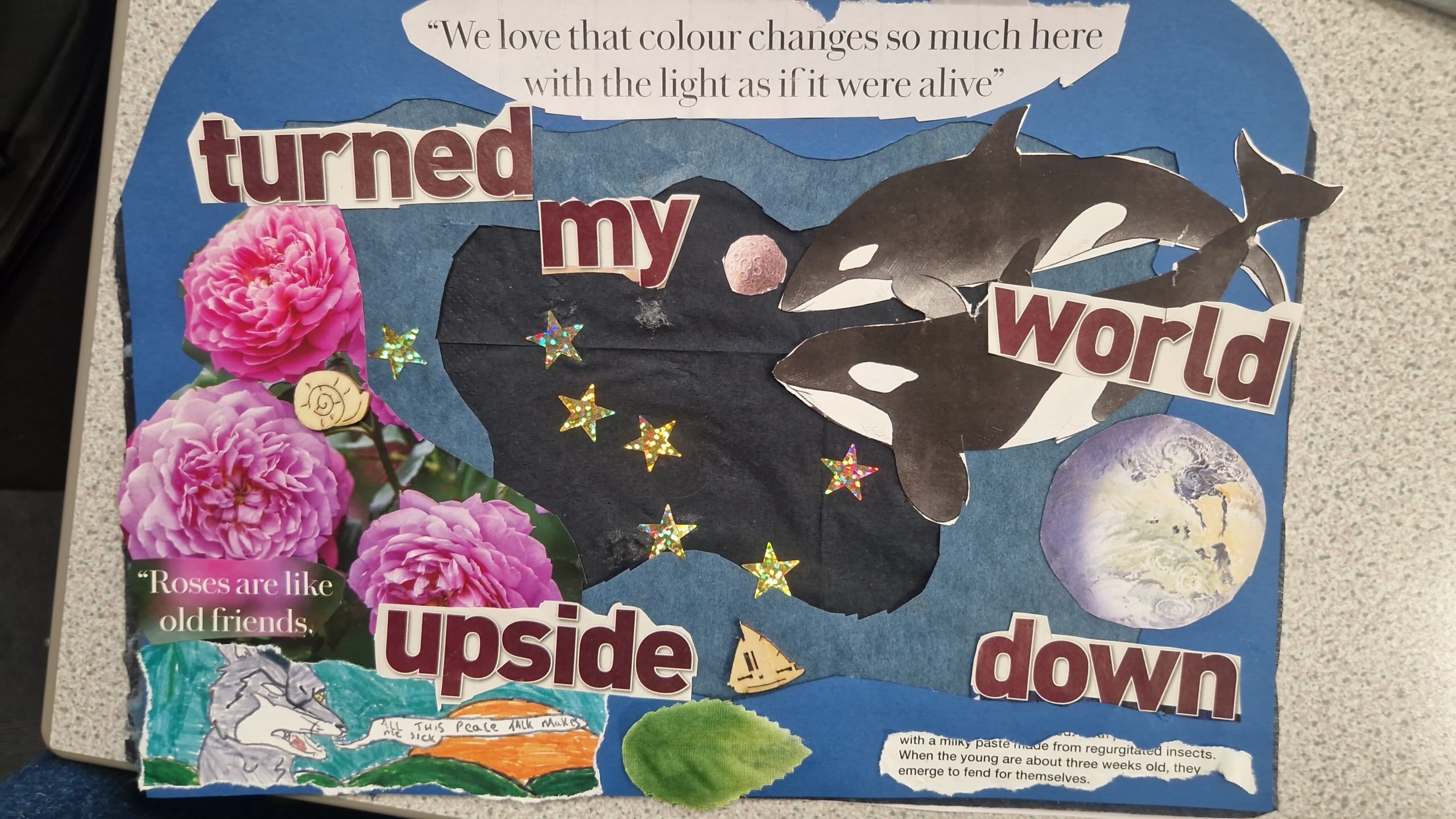
We created a River of Recovery and made zine pages using collage. We reflected on Maya Angelou, silenced voices, resistance and the relationship between individual and social recovery. A discussion about public art and protest challenged us to think beyond recovery as a private psychological process. Recovery may also involve collective memory, solidarity and making injustice visible.
During the day, I told part of my own story to an audience for the first time. I spoke about life modelling, doula work and the retreats I have organised. These have all been connected, for me, with repossessing embodiment: finding ways to inhabit a body that belongs to me and to use it on my own terms.
Creative methods allowed this to emerge differently from an ordinary meeting. An object, fragment of writing or piece of music could hold something that might have been flattened by formal research language. People retained control over how much they shared and what remained private.
What changed between us
The day also changed how I experienced the relationship between the LEAG and the research team.
We had time to encounter one another as people. Members of the research team participated in the activities, listened and allowed their own thinking to be unsettled. Different meanings of recovery were able to remain alongside each other without being forced into an agreed definition.
That experience strengthened my trust in the group and in the research process. It also demonstrated why relationships are part of the work rather than an optional addition to it.
The LEAG’s role has gradually developed beyond commenting on plans. Members have contributed to research safety and ethics, recruitment, study direction, creative methods and public engagement. We have also been invited into more active roles in shaping practitioner focus groups and considering how survivor narratives can be used publicly without becoming extractive.
The creative day helped make that deeper involvement more possible. Once people have written, listened, made things and shared space together, subsequent conversations begin from a different place.
Recovery as something we do together
I still feel ambivalent about the word recovery. It can imply a destination or an obligation to become well in a recognisable way. It can place responsibility on an individual while leaving the conditions that harmed them unchanged.
Yet the creative day opened other possibilities within the word.
Recovery might involve repossessing language, embodiment, creativity and the authority to interpret our own lives. It might include resistance, public memory and collective action. It might mean finding relationships in which our realities are heard and believed.
For me, the day was also a reminder that survivor involvement should have value in the present. Its worth cannot rest entirely on a future publication, exhibition or research finding. The experience of being listened to, influencing decisions and building relationships is itself part of what ethical involvement should offer.
The day did not produce a final definition of recovery. It gave us something more useful: a richer language, stronger relationships and a greater capacity to continue the work together.
Further Reading
Selina reflects further on survivor-informed and trauma-informed public involvement in her open-access article, “The survivor researcher voice: reflections on lived experience, equity and community engagement in health research”, published in Research for All.
https://doi.org/10.14324/RFA.10.1.11
MORE INFO ABOUT THE PROJECT
www.shra.bbk.ac.uk/projects/recovery-histories/
CONTACT US
Telephone: 020 3926 3679/ 020 3926 2813
E-mail: recovery-histories@bbk.ac.uk
